
What Scalable Restoration Requires - Timeline, Gear, Team and Permits
TLDR
Scalable kelp restoration isn’t just about planting seaweed, it’s about systems. It requires the right seasonal timing, durable infrastructure, skilled teams, permits, and long-term monitoring. Success depends on aligning biology with logistics and site conditions. Without planning, data, and follow-through, restoration efforts won’t last. Scale comes from repeatable design, not one-off deployments.
Why “scalable” kelp restoration is often misunderstood
Kelp restoration is often discussed in the language of scale: hectares restored, kilometres of coastline, tonnes of biomass. But you cannot scale kelp restoration by adding ambition. You scale it by building a system that survives contact with the ocean.
At West Coast Kelp, “scalable” does not mean “faster.” It means repeatable outcomes across sites and seasons, with predictable effort, cost, and risk. That requires aligning biological timelines, physical infrastructure, skilled teams, and regulatory frameworks into a system that can operate repeatedly and reliably.
Kelp does not scale on startup timelines. It scales on ecological ones.
Timelines: Restoration happens on ecological, not funding, clocks
One of the most common misconceptions about kelp restoration is that it can be accelerated indefinitely. In reality, restoration is governed by seasonal and biological constraints that cannot be bypassed.
Spore collection, nursery cultivation, and outplanting must align with species-specific life cycles and environmental windows. Miss a window and the project does not slow down, it resets.
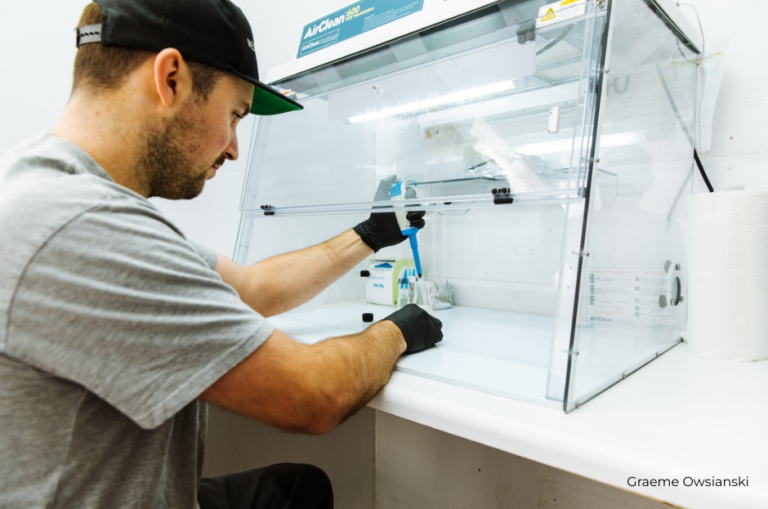
Here is what this looks like in practice:
- Field collection window (species and region dependent) to obtain healthy reproductive material
- Nursery cultivation lead time to produce consistent, deployment-ready material
- Outplanting window that matches local conditions and weather opportunity
- Monitoring window that captures early survival and performance signals before the next cycle
Annual species such as bull kelp compress timelines further. With a tighter seasonal arc, you have less room for delays in permitting, vessels, weather, or seed supply. Ignore these constraints and you scale failure, not restoration.
Scalable restoration depends on planning at least one full year ahead, often more. Timelines must account for cultivation lead time, deployment windows, weather contingencies, and post-outplant monitoring. Operationally, that means building a calendar that starts with biology, then working backward to procurement, crew scheduling, and permitting milestones.
Gear and infrastructure: Scaling is physical, not theoretical
Restoration at scale is fundamentally constrained by gear. Nursery systems, bioreactors, grow-out infrastructure, vessels, moorings, and monitoring equipment define how much restoration can realistically be supported at any given time.
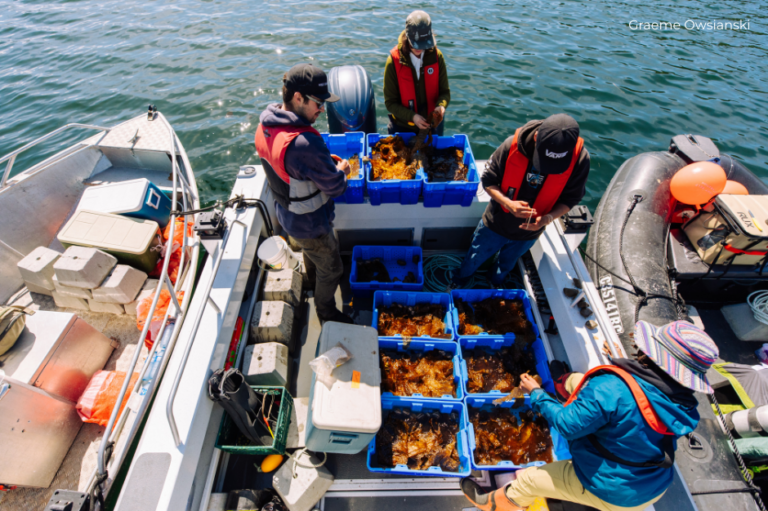
At small scales, ad hoc setups can work. At larger scales, consistency becomes essential. You need standardized systems that produce reliable outputs, plus the flexibility to adapt to different sites and species.
In the ocean, “scaling gear” is not just about volume. It is about durability, redundancy, and maintenance:
- Durability: moorings, lines, and attachment systems have to hold up in high-energy environments
- Redundancy: backups for critical components (and a plan for fast replacement) prevent a single failure from compromising a whole cohort
- Maintenance: inspection and servicing are not optional, they are part of the production cycle
Equipment failure mid-season can erase months of upstream work. If you want repeatability, infrastructure planning cannot be an afterthought. It becomes part of the restoration design.
Team and expertise: Restoration is interdisciplinary work
Scalable kelp restoration does not hinge on a single skill set. It requires a team that spans nursery science, field operations, data collection, project management, and regulatory coordination.
In practice, this means people must be able to move fluidly between lab and ocean environments, while staying aligned on shared constraints. Nursery specialists need to understand downstream deployment realities. Field teams must work within biological tolerances established upstream. Monitoring and data staff must translate ecological signals into actionable insights for the next cycle.
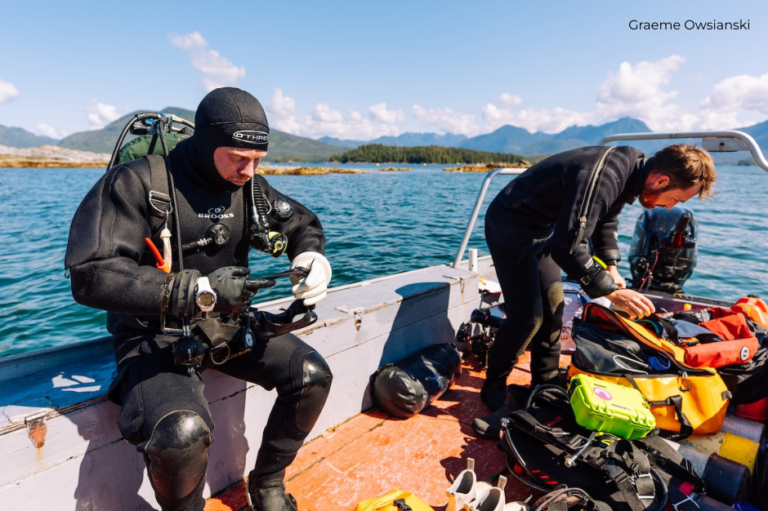
As scale increases, coordination becomes as important as expertise. Repeatability depends on:
- Clear roles (who owns nursery outputs, field deployment, monitoring, and reporting)
- Shared protocols (how work is done, documented, and improved)
- Decision frameworks (what triggers a delay, a pivot, or a redeploy)
Without that operating system, scaling tends to produce fragmentation: disconnected activities that look busy but do not compound into reliable outcomes.
Permits and governance: The invisible backbone of scale
Permitting is often treated as a hurdle to clear rather than a system to integrate. In reality, permits define where, when, and how restoration can occur and therefore directly shape scalability.
Each site operates within a specific regulatory context that governs species selection, deployment methods, monitoring requirements, marking, and reporting obligations. Scaling restoration means navigating these frameworks repeatedly, often across multiple jurisdictions or partners, while maintaining consistency in documentation and compliance.
At WCK, permitting is treated as part of restoration design, not an afterthought. The practical difference is simple: early engagement and strong documentation reduce delays, which reduces the chance that an entire season is lost to timing.
When permitting is integrated early, projects are more likely to move from pilot to repeatable implementation. When it is deferred, scaling efforts tend to stall regardless of ecological readiness.
What breaks when teams try to scale too quickly
Most “scaling” failures are not about intent. They are about bottlenecks and cascading delays. The usual failure modes are:
- Missed biological windows that force a full reset
- Gear bottlenecks or failures mid-season that compromise a cohort
- Permitting delays that push deployment outside viable environmental windows
A scalable program is one that is designed to absorb these risks without losing the entire cycle.
Conclusion: Scaling restoration is about systems, not shortcuts
Scalable kelp restoration is not achieved through ambition alone. It emerges from systems that align biological reality with operational discipline.
Timelines must respect life cycles. Gear must support repetition, not experimentation alone. Teams must integrate science, fieldwork, and coordination. Permits must be woven into project design rather than worked around.
When these elements align, restoration becomes not just possible, but repeatable.
If you are planning a kelp restoration project for next season, planning starts now. The earlier you align biology, gear, team, and permits, the more likely your “scale” translates into real biomass in the water and usable monitoring data for the cycle after that.